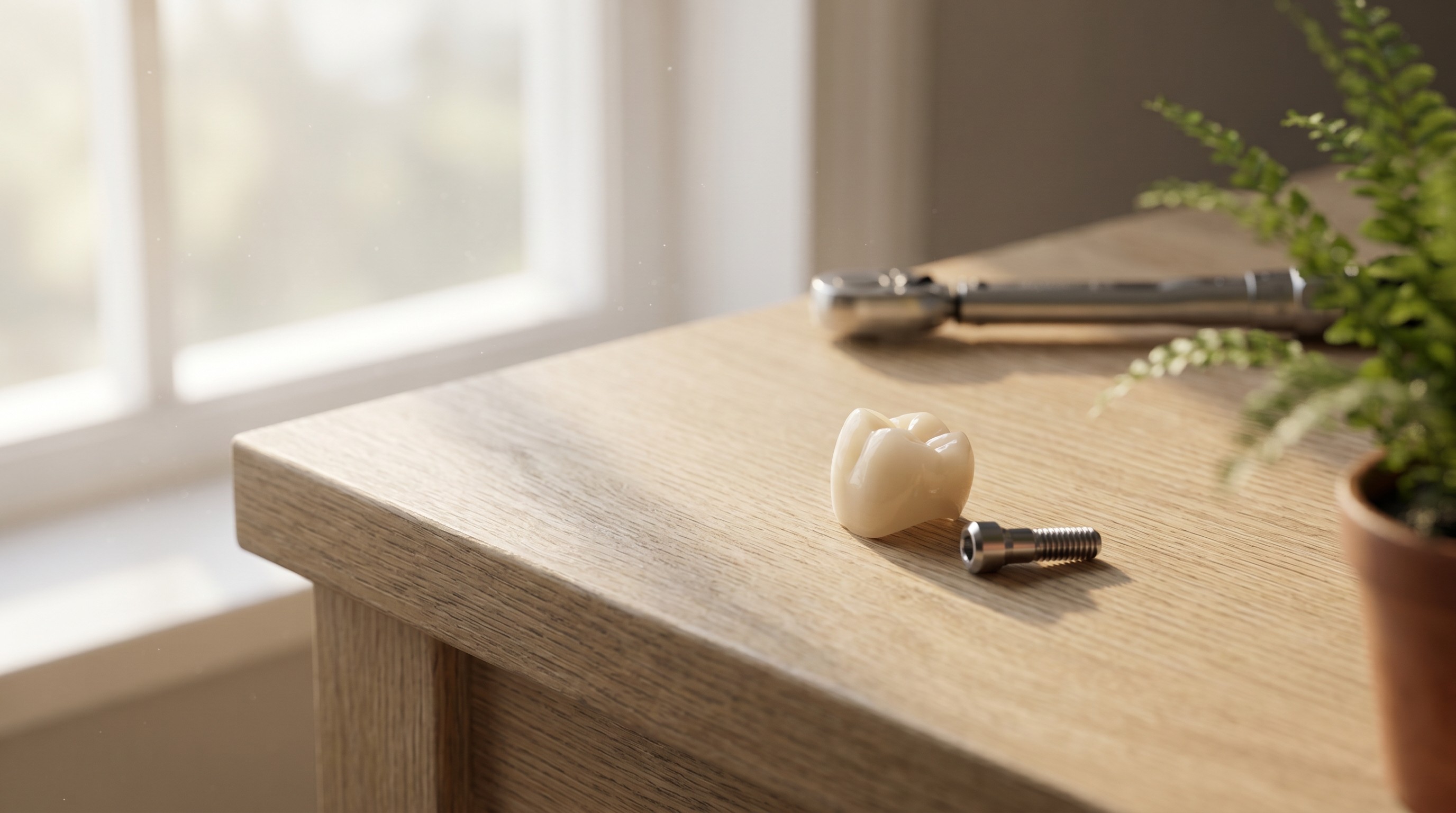
Why does my dental implant make a clicking sound when I chew?
A clicking sound from a dental implant when you chew is most often caused by a loose abutment screw, a high bite contact, or worn prosthetic parts. Because implants lack the cushioning ligament of natural teeth, sounds transmit more directly through bone. A new or repeatable click should be evaluated promptly. Most fixes take under an hour.
At Inspire Dental in Tigard, we hear this question often from patients in King City and Summerfield who have lived comfortably with an implant for years and suddenly notice a new tap when their teeth meet. It can feel alarming. The good news is that the cause is almost always mechanical, fixable, and not an emergency in the dramatic sense. Still, ignoring it can turn a five-minute fix into a much bigger repair.
What does a clicking implant actually sound like?
Patients describe it different ways. A tap. A click. A faint tick when the back teeth touch. Some hear it only with crunchy foods, others notice it even when they swallow.
One detail surprises people. The sound often feels louder to you than to anyone sitting across the table. That is because your jawbone conducts vibration straight to your inner ear. A small click in the mouth can sound like a snap inside your own skull.
Is a clicking dental implant normal?
A faint click during firm biting can be normal sound conduction. Natural teeth sit in a periodontal ligament, a thin shock absorber of fibers that wraps each root. Implants do not have that ligament. They fuse directly to bone, which is wonderful for stability but means force and sound transmit more directly. According to prosthodontic biomechanics research, this is why an implant crown can feel and sound different from the tooth it replaced.
So a quiet, occasional tap when you really clench down? Often harmless. A new, repeatable click that was not there a month ago? Worth a visit. That is the line we draw.
Common causes of a clicking or tapping implant
In our office, the short list of culprits stays remarkably consistent:
Loose abutment screw. The most common mechanical cause by far.
High occlusal contact. The crown hits opposing teeth a hair before the others do.
Worn or fractured prosthetic parts. Years of chewing wear down ceramics and metals.
Cement washout under a cemented crown, leaving a tiny gap.
Adjacent tooth movement. Your natural teeth drift over time, while the implant does not. That subtle shift can change how everything fits together.
A single click can have one cause or two stacked on each other. Part of our job is telling them apart.
Why loose abutment screws happen
Your implant crown is held to the implant body by a small screw, torqued to a specification set by the manufacturer. Under normal chewing, that screw stays put. But chewing is cyclic loading, the same kind of repeated stress that eventually loosens any bolt. According to systematic reviews in Clinical Oral Implants Research, abutment screw loosening is among the most common mechanical complications of single-tooth implant restorations.
Grinding makes it worse. Patients who clench at night, common in busy professionals commuting the 99W corridor, deliver many times the normal force to that screw. Research in the International Journal of Oral and Maxillofacial Implants links bruxism to higher rates of screw loosening and prosthetic complications.
Here is the part that matters. Caught early, a loose screw is a fifteen-minute fix. Ignored, the screw can fatigue and fracture inside the implant body, which is far harder to retrieve. The Journal of Prosthetic Dentistry notes that screw fracture is significantly more difficult to repair than simple loosening. Call when you first notice the sound. Not in six months.
When to call your Tigard dentist
You do not need to panic over every chew sound. But please call if you notice any of these:
A new clicking that was not there before
Any sense of wiggle, micro-movement, or rotation in the crown
Food packing alongside the new sound
Pain, swelling, or a bad taste with the click
The sound getting louder or more frequent week over week
For established implant patients, we usually offer same-day evaluation. A click that started this morning often gets seen this afternoon.
What to expect at the appointment
The visit is straightforward and almost always quick. Here is what we typically do:
Bite check with articulating paper. A thin colored film that marks exactly where your teeth touch. This is the ADA standard for finding high contacts.
Periapical X-ray. A close-up image to check the screw position and the bone level around the implant.
Crown removal if screw-retained. We unscrew the crown, inspect the components, replace the screw if needed, and retorque to spec.
Occlusal adjustment if the contact is too heavy, polishing down a few microns of porcelain.
Recement if a cemented crown has lost its seal.
Most clicks resolve in under an hour. Patients walk out, bite down, and the sound is gone. That is the whole trick.
A recent example. A retired patient from Summerfield, in his late sixties, came in for what he called a tick when he ate his morning toast. His implant had been placed eight years earlier by one of the prior dentists at this location. We took one small X-ray, lifted the screw-retained crown, retorqued the abutment, checked his bite, and sent him home. The whole visit took thirty-five minutes. He told us he had almost not called because the sound seemed too small to mention.
Small sounds matter. Especially with implants.
Frequently Asked Questions
Can a clicking implant fix itself?
No. The mechanical issues that cause clicking, a loose screw, a high bite contact, a worn part, do not self-correct. They tend to get worse with continued chewing pressure. The fix is almost always quick when caught early, so there is no reason to wait it out.
Will my implant fall out if the screw is loose?
The implant itself, the part fused to your bone, is not coming out from a loose screw. What can fail is the crown on top of it. A loose abutment screw can let the crown rotate, fracture, or eventually allow the screw itself to break. The implant body stays put, but the repair gets more complicated the longer it waits.
Is the clicking sound dangerous to the bone around my implant?Not directly, but a poorly fitting crown can create asymmetric load on the bone over time. Persistent high contact or a loose component changes how force transmits into the jaw, and chronic overload is one factor in bone loss around implants. Fixing the click early protects the bone.
How long does it take to tighten a loose abutment screw?
The actual retorquing takes a few minutes. The full appointment, including X-ray, removing the crown, checking the parts, retorquing, and verifying your bite, usually runs under an hour.
Can grinding my teeth at night cause my implant to click?
Yes. Bruxism is one of the most established risk factors for screw loosening and prosthetic wear on implants. If you grind, we often recommend a custom night guard to protect both the implant and your natural teeth. It is one of the simplest investments you can make in the lifespan of your restoration.
If you have noticed a new sound from your implant, give us a call at Inspire Dental in Tigard at (503) 639-4330. We are on Pacific Highway near the Bull Mountain and King City border, and we can usually see established implant patients the same day.